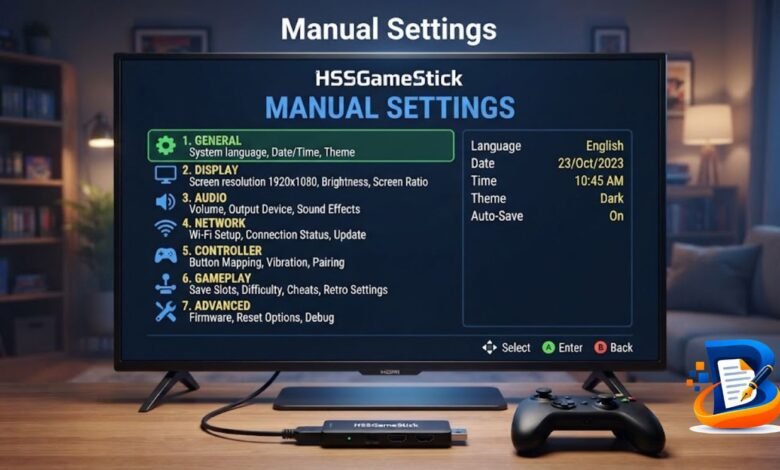
If you are searching for manual settings HSSGameStick, you are probably trying to do more than simply plug the device into your TV and start playing. You may want to correct the screen size, change controller behavior, improve picture quality, fix audio problems, or understand which settings are safe to change.
The key point is that HSSGameStick products and software versions can differ. Online guides describe different menus, emulator systems, and hardware configurations, so a setting shown on one version may not appear on another. That makes it better to understand what each setting does rather than blindly copying a particular configuration.
This guide explains the major areas you are likely to encounter when configuring an HSSGameStick, including display, aspect ratio, controller mapping, sensitivity, audio, emulator options, storage, connectivity, troubleshooting, and resetting. Where exact menu names vary between versions, the guide explains the function instead of presenting an unverified menu path as universal.
What Are Manual Settings HSSGameStick?
Manual Settings HSSGameStick are configuration options that allow you to adjust how the game stick behaves instead of simply accepting its existing defaults.
For a retro gaming device, those adjustments can affect the display output, controller input, audio, emulator behavior, interface, network connection, and other system functions. Several online guides describe HSSGameStick as an HDMI-connected retro gaming device that uses an interface and emulation software to provide access to older-style games. However, the exact hardware and software configuration can vary by model or version.
That distinction matters because there is no reliable reason to assume that every HSSGameStick has exactly the same settings menu.
A practical approach is therefore to treat the instructions that came with your particular device as the primary reference. Online information can help you understand a setting, but it should not override model-specific instructions.
Why Manual Settings HSSGameStick Matter
A plug-and-play game stick is intended to work with minimal setup. However, a default configuration cannot account for every television, controller, room, or personal preference.
For example, your TV may display a picture with black bars because the game’s original aspect ratio is different from the television’s widescreen format. Your controller may feel uncomfortable because its button layout does not suit the way you play. Audio may also need adjustment if the television or external sound system handles the HDMI signal differently.
Manual configuration gives you greater control over these situations.
It does not automatically make every game run better. In fact, changing the wrong option can sometimes make the experience worse. The goal should be controlled adjustment: change one setting, test it, and keep the change only if it produces the result you want.
How to Access Manual Settings HSSGameStick
The exact route depends on the software installed on your device. Online guides commonly describe accessing a main menu and then entering a settings, system, game, or emulator configuration area. Some versions may expose emulator-specific options separately from general device settings.
Start by turning on the Manual Settings HSSGameStick and waiting for its main interface to load. Use the controller to locate the settings area. Look for labels such as Settings, System Settings, Game Settings, Controller Settings, Display, or Emulator Settings.
Do not assume that a setting is global simply because you found it in a menu. Some configurations affect the whole system, while others apply to an individual emulator or game.
This distinction is particularly important when changing controller mapping, video filters, aspect ratio, or emulator-specific options.
If you cannot find an option described in an online guide, that does not necessarily mean your device is defective. It may simply use different firmware or a different interface.
Display Settings and Resolution
Display configuration is one of the most useful areas to understand.
Resolution determines how the device outputs the picture to your television or monitor. Common resolutions discussed in HSSGameStick guides include 720p and 1080p, although the options available on a particular model should be checked directly on the device.
For a modern Full HD television, a 1080p output may be an appropriate starting point if the device offers it and the display supports it. On an older television or a device with different output capabilities, another resolution may be more appropriate.
The important rule is simple: use a resolution supported by both the game stick and the display.
Changing resolution is not the same thing as increasing the original resolution of a retro game. An older game can still have a low native resolution even when the console outputs the image to a modern 1080p television.
Understanding Aspect Ratio
Aspect ratio controls the relationship between the width and height of the displayed image.
Many classic games were designed for older television formats rather than modern widescreen displays. If you force such a game into a widescreen shape, characters and objects may appear stretched.
A 4:3 presentation can preserve the proportions associated with many older games, while 16:9 fills a modern widescreen display but can change the appearance of the original image.
Some emulator configurations also provide scaling or integer-scaling options. These can help preserve the appearance of pixel-based graphics instead of simply stretching them across the screen. Online HSSGameStick guides describe 4:3, 16:9, and scaling-related options, but the exact choices depend on the software version.
| Display option | What it controls | Practical consideration |
|---|---|---|
| Resolution | Output image size | Match a supported setting on your display |
| 4:3 aspect ratio | Traditional display proportions | Often suitable for older games |
| 16:9 aspect ratio | Widescreen presentation | Can stretch older content |
| Scaling | How the original image is enlarged | Useful when preserving pixel proportions matters |
There is no single aspect ratio that is best for every game. If preserving the original appearance matters to you, avoid assuming that filling every inch of the television is automatically better.
Controller and Input Settings
Controller configuration can have a greater effect on comfort than graphics settings.
Depending on the Manual Settings HSSGameStick version, you may encounter options for button mapping, controller pairing, sensitivity, or emulator-specific input configuration. Online documentation about HSSGameStick describes manual button mapping as a way to assign actions to preferred buttons.
Button mapping is especially useful when a game’s original control scheme feels unfamiliar on a modern controller.
However, change mappings carefully. If you remap several buttons without recording the original configuration, it can become difficult to remember what each button previously did.
Understanding Sensitivity
Sensitivity determines how strongly an input responds to movement. The meaning depends on the specific game or emulator.
A higher sensitivity can make an input respond more quickly, while a lower setting can provide more gradual movement. Neither is universally superior.
It is also important not to confuse a game-specific sensitivity option with a system-wide controller setting. A sensitivity adjustment available inside one emulator may not affect another emulator or game.
For that reason, make a small adjustment and test it in the same game where you noticed the problem.
Controller Pairing and Input Delay
Wireless controllers can occasionally experience pairing or response problems. Before changing advanced settings, check the simple causes.
Make sure the controller is properly paired with the receiver or console. Check the batteries or power level if the controller uses replaceable or rechargeable power. Also make sure the receiver is properly connected.
If the controller works in one part of the interface but not inside a particular game, the problem may be an input configuration rather than a hardware failure.
Audio Settings
Audio problems can be frustrating because the video may appear completely normal while sound is missing, distorted, or routed incorrectly.
The HSSGameStick’s audio options may include volume, output mode, or other sound-related controls depending on the model. Some online guides describe HDMI audio configuration and additional audio controls, but these should be treated as version-dependent rather than universal features.
Start with the simplest checks.
Make sure the television is not muted. Confirm that the correct HDMI input is selected. Check the device’s volume level and then examine any available audio output option.
If you are using a soundbar, receiver, or other external audio equipment, the signal path can introduce additional variables. Test the HSSGameStick directly through the television first if possible. That can help determine whether the issue originates with the game stick or the external audio setup.
Avoid Changing Too Many Audio Options at Once
Audio configuration can become confusing when several settings are changed simultaneously.
If stereo works but another audio mode does not, return to the known-working configuration before experimenting further. A simple working setup is usually more useful than an advanced configuration that introduces compatibility problems.
Emulator Settings and Game-Specific Options
Retro game sticks commonly rely on emulation, which means software reproduces the behavior of older gaming hardware.
This is why you may see emulator-specific settings in addition to general system settings. Online HSSGameStick material references options such as display filters, scanlines, shaders, controller mappings, and emulator configurations.
A shader or filter can change the visual appearance of a game. For example, a scanline effect may attempt to recreate the look associated with older displays. Smoothing can produce a softer image, while a more direct pixel presentation may look sharper.
These are aesthetic choices rather than universal performance improvements.
If you want a cleaner modern presentation, you may prefer minimal filtering. If you want a more traditional retro appearance, you may prefer a filter or scanline effect where available.
Global Settings Versus Game Settings
This is one of the most important concepts in manual configuration.
A global setting may affect multiple games or emulators. A game-specific setting may affect only the current title. If you change a global controller mapping when you intended to change one game, you could unexpectedly alter the controls elsewhere.
Before saving an advanced setting, check whether the interface identifies it as a global, core, emulator, or game configuration.
Performance Settings and Lag
When a game feels slow, it is tempting to change every graphics option immediately. That approach can make troubleshooting harder.
First determine what kind of lag you are experiencing.
If the entire interface responds slowly, the issue may involve the device, storage, power, or system software. If only one game behaves poorly, the problem may be specific to that title or emulator. If the controls feel delayed while the picture remains smooth, input or display processing may be involved.
Some online guides recommend reducing demanding graphics options or changing output settings when performance problems occur.
However, avoid treating every lag problem as a resolution problem. A lower output resolution does not necessarily fix every form of emulator slowdown or controller delay.
A better troubleshooting method is to change one relevant setting at a time and test the same game again.
Network and Connectivity Settings
Not every HSSGameStick use case requires an internet connection. If your particular model includes network functionality, however, its network settings may be relevant to updates or other online features.
Some guides describe Wi-Fi and Ethernet-related options on certain versions.
Do not assume that a game stick supports every network feature mentioned in an online guide. Check the hardware and software on your specific device.
If an online function is not working, verify that the device actually has the required connectivity hardware and that the network option is available in its own settings menu.
Storage and Game Management
Storage is another area where users should be cautious.
Some HSSGameStick products are sold with games stored on removable media, while configurations can differ between products. Online descriptions mention SD or TF-style storage on some versions, but you should verify the storage arrangement of your specific device before removing or modifying anything.
Do not format a storage card simply because a guide recommends it. Formatting can erase data.
If you are trying to add, remove, or organize games, first determine how your particular device stores its game library and whether the manufacturer or seller provides instructions for managing that storage.
Saving Your Settings
One common mistake is changing a setting without determining whether the change has actually been saved.
Some interfaces apply changes immediately. Others require a save command or a configuration option. Emulator-based systems can also have separate methods for saving configuration.
After making an important change, restart the affected game or system and verify that the setting remains.
If a setting disappears after reboot, check whether your software requires a separate save step. Do not repeatedly change the same setting without first determining how configuration persistence works on your version.
A Practical Configuration Approach
There is no universal “best” manual settings HSSGameStick configuration because users have different televisions, controllers, games, and preferences.
Instead, use a stable baseline and make gradual changes.
| Area | Sensible starting approach | What to test |
| Resolution | Use a supported display mode | Picture clarity and stability |
| Aspect ratio | Preserve original proportions when desired | Stretching or black bars |
| Controller mapping | Keep a familiar layout | Comfort and correct inputs |
| Sensitivity | Start conservatively | Movement precision |
| Audio | Use a simple compatible output | Clear sound |
| Filters | Start without aggressive effects | Image sharpness and appearance |
| Advanced emulator settings | Leave defaults initially | Only change when a specific problem exists |
This method is more reliable than copying a random list of numbers from the internet.
Common Problems With Manual Settings HSSGameStick
The Picture Does Not Fill the Screen
Check the aspect ratio and scaling options. A 4:3 setting can intentionally leave space on the sides of a widescreen television. That is not necessarily a fault.
If the picture looks stretched, avoid correcting it simply by forcing the image to fill the entire display.
The Picture Looks Blurry
Check the output resolution and scaling configuration. Also consider the original resolution of the game. Increasing the television output does not transform low-resolution retro graphics into native high-resolution artwork.
The Controller Does Not Respond
Check pairing, power, receiver connections, and button mapping. If the controller works in the system menu but not in one game, examine that game’s input configuration.
The Controller Feels Delayed
First determine whether the delay comes from the controller, game, emulator, or television processing. Avoid changing several input settings simultaneously because that makes the cause harder to identify.
The Sound Is Missing
Check television volume, HDMI selection, and the HSSGameStick audio configuration. If external audio equipment is involved, test the device directly through the television where practical.
A Game Stops Working After a Setting Change
Return the affected configuration to its previous value. If you cannot remember what changed, use the relevant reset or restore option if your version provides one.
Do not immediately perform a full factory reset unless simpler recovery options have failed.
Should You Reset HSSGameStick Settings?
A reset can be useful when configuration changes have created a problem that you cannot identify. However, a reset should be considered a recovery step rather than a routine optimization technique.
Online guides describe reset or restore options on HSSGameStick configurations, but the exact process can vary.
Before using a factory reset, determine what data and settings could be removed. If your device contains saved configurations or other user data that you want to preserve, do not assume a reset will leave everything untouched.
If the device has a simple “restore defaults” option, that may be preferable to a complete factory reset when the problem is limited to configuration.
How to Avoid Problems When Changing Settings
The safest approach is to make deliberate changes.
Do not change five settings at once and then try to determine which one fixed or caused the problem. Instead, adjust one category, test it, and move on.
It is also useful to record important original values before experimenting. A quick note about the previous resolution, aspect ratio, controller mapping, or emulator configuration can save considerable time if you decide to undo the change.
Be particularly careful with storage, firmware, and advanced emulator options. A display setting can usually be reversed easily, while an inappropriate storage or system-level change can create a more serious problem.
Is Manual Configuration Worth It?
For many HSSGameStick users, manual configuration is useful because it allows the device to better match the television and personal preferences.
The biggest benefit is control. Instead of accepting one configuration, you can decide how the image should be presented, how the controller should behave, and which optional visual or audio features you actually want.
However, manual settings are not a guarantee of better performance. A setting that improves one game can make another look or feel different. Likewise, an option that works on one version of the HSSGameStick may not exist on another.
That is why understanding the purpose of a setting is more valuable than copying a preset.
Frequently Asked Questions
What are manual settings HSSGameStick?
Manual settings HSSGameStick refers to the configurable options used to adjust the device’s display, controller behavior, audio, emulator configuration, and other functions. The exact options depend on the particular hardware and software version.
What resolution should I use on HSSGameStick?
Use a resolution supported by both your HSSGameStick and television. If your device offers 1080p and your television supports it, 1080p can be a reasonable starting point for a Full HD display. For other displays, use the compatible option shown by your device.
Should retro games use 4:3 or 16:9?
It depends on how you want the game to look. Many older games were designed around narrower display proportions, so 4:3 can preserve their original shape. A 16:9 presentation fills a modern widescreen display but may stretch the image.
Can I change HSSGameStick controller buttons?
If your version provides controller mapping, you may be able to assign different actions to different buttons. The available controls and menu structure vary by version.
Why is my HSSGameStick controller not working?
Start with basic checks such as controller power, pairing, receiver connection, and input mapping. If it works in the main menu but not in a particular game, inspect that game’s emulator or controller configuration.
Can changing manual settings damage the HSSGameStick?
Ordinary display, audio, and controller adjustments are generally configuration changes rather than physical modifications. Nevertheless, advanced system, firmware, or storage changes should be approached carefully because the consequences depend on the device and software version.
Why does my HSSGameStick have different settings from an online guide?
HSSGameStick configurations can differ by model, firmware, emulator, and software interface. Online guides themselves show different menu structures and feature sets, which is why you should use your device’s own documentation as the final reference for model-specific instructions.
Do manual settings apply to every game?
Not necessarily. Some settings can be global, while others may belong to a specific emulator or game. Check the configuration screen before assuming that a change will affect the entire game library.
How can I restore the original configuration?
Look for a restore-defaults or reset option in your device’s system settings. The exact procedure varies. Before performing a factory reset, consider whether it could erase saved settings or other data.
Conclusion
Learning manual settings HSSGameStick is less about finding a magic configuration and more about understanding what each option actually changes. Display resolution and aspect ratio affect how games appear, controller mapping changes how you interact with them, audio settings control the sound path, and emulator options can alter the visual presentation or behavior of individual games.
Because HSSGameStick models and software configurations can differ, avoid treating an online settings guide as a universal manual. Start with the documentation supplied with your device, make one change at a time, and test the result before moving to another setting.
The best setup is ultimately the one that gives you a stable picture, comfortable controls, clear audio, and the presentation you prefer without unnecessary changes. When approached carefully, manual settings HSSGameStick can make the device easier to customize while keeping troubleshooting straightforward.