
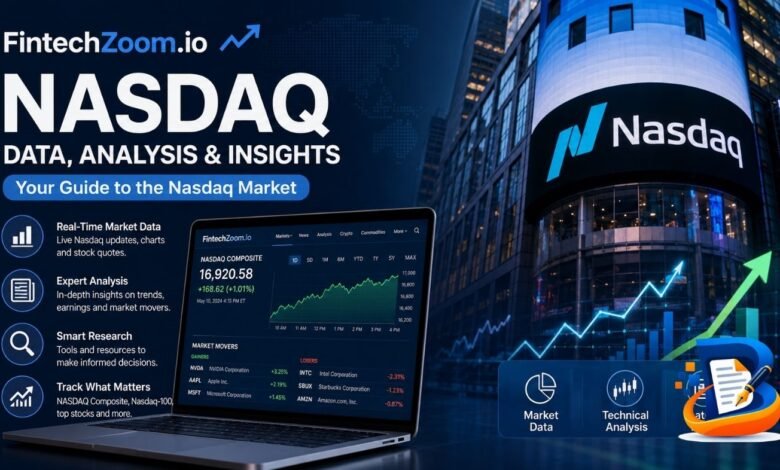
Searching for fintechzoom.io nasdaq usually means you want to understand how FintechZoom.io covers the Nasdaq market, where its Nasdaq information comes from, and whether it can help you research stocks and market trends.
FintechZoom.io presents itself as a financial technology and research website covering markets such as Nasdaq, the Dow Jones, cryptocurrency, precious metals, and other financial topics. Its Nasdaq coverage focuses on market movements, technology companies, earnings reports, charts, and related analysis.
However, there is an important distinction for U.S. investors: FintechZoom.io is not Nasdaq itself. Nasdaq is the operator of the Nasdaq Stock Market and publishes official information about its indexes, methodologies, listed securities, and market data. FintechZoom.io is a separate financial-content website that discusses and analyzes markets.
That distinction matters when you are researching an investment. A financial website can help you discover information, understand market concepts, or follow a topic. However, investment decisions should be based on information that you can verify through authoritative sources, company filings, your brokerage, and other reliable financial resources.
This guide explains the relationship between FintechZoom.io and Nasdaq, the difference between the Nasdaq Composite and Nasdaq-100, how to interpret Nasdaq information, and what U.S. investors should check before acting on financial content.
What Is FintechZoom.io?
FintechZoom.io describes itself as a media and financial research platform focused on financial technology. According to its website, it covers stock markets, cryptocurrencies, commodities, real estate, and other areas of finance. It specifically highlights Nasdaq and the Dow Jones among the markets it follows.
The website also has a dedicated page titled “Nasdaq FintechZoom,” which discusses Nasdaq market tracking, charts, technical information, news, and market analysis.
For someone searching the phrase “fintechzoom.io nasdaq,” the simplest way to understand the relationship is this:
| Term | What it refers to |
|---|---|
| FintechZoom.io | A financial media and research website |
| Nasdaq Stock Market | A major U.S. electronic stock market |
| Nasdaq Composite | An index covering a broad group of Nasdaq-listed stocks |
| Nasdaq-100 | An index tracking 100 large non-financial Nasdaq-listed companies |
| FintechZoom Nasdaq coverage | Third-party information and analysis about Nasdaq and related markets |
FintechZoom.io can therefore be viewed as a source of market-related content rather than as the Nasdaq exchange itself.
That difference is particularly important because online financial content can sometimes use “Nasdaq” to describe several different things. A reader may be looking for the stock exchange, the Nasdaq Composite, the Nasdaq-100, or a particular Nasdaq-listed company.
What Does FintechZoom.io Nasdaq Mean?
The phrase fintechzoom.io nasdaq is not the name of a separate stock exchange or investment product. It generally refers to FintechZoom.io’s coverage of the Nasdaq market and its related indexes.
The site’s dedicated Nasdaq article describes tools and information related to market performance, charts, technical analysis, news, and historical market information.
This type of coverage can be useful when you are trying to understand what is happening in the market. For example, you might use a financial website to identify a major market trend and then investigate the underlying companies using primary sources.
Still, readers should avoid treating a financial article as an automatic buy or sell signal. Market commentary is different from verified company information, and an index movement alone does not tell you whether an individual stock is attractive at a particular price.
What Is Nasdaq?
Nasdaq is one of the major U.S. stock markets. It is also the name used for a family of market indexes, which is where some of the confusion begins.
The Nasdaq Stock Market is an electronic marketplace where securities are traded. The word “Nasdaq,” however, can also refer to indexes such as the Nasdaq Composite and Nasdaq-100.
The Nasdaq Composite is a broad index of stocks listed on the Nasdaq Stock Market. Nasdaq describes it as a market-capitalization-weighted index that includes thousands of listed companies across different industries, with significant exposure to technology and innovation.
The Nasdaq-100 is different. It tracks 100 of the largest non-financial companies listed on the Nasdaq Stock Market. Its companies come from several industries, including technology, retail, healthcare, telecommunications, biotechnology, transportation, media, and services.
Understanding this difference is essential when reading Nasdaq coverage on any website, including FintechZoom.io.
Nasdaq Composite vs. Nasdaq-100
The Nasdaq Composite and Nasdaq-100 are often mentioned together, but they are not interchangeable.
The Nasdaq Composite is broader. It includes thousands of Nasdaq-listed stocks and therefore provides a wider view of companies trading on the exchange.
The Nasdaq-100 is more selective. It focuses on 100 of the largest non-financial companies listed on Nasdaq and uses a modified market-capitalization weighting approach. Nasdaq reviews and rebalances the index according to its established methodology.
| Feature | Nasdaq Composite | Nasdaq-100 |
|---|---|---|
| Coverage | Broad group of Nasdaq-listed stocks | 100 large non-financial Nasdaq-listed companies |
| Scope | Broad market representation | Large-cap, growth-oriented exposure |
| Financial companies | Included where eligible | Excluded |
| Weighting | Market capitalization based | Modified market capitalization based |
| Common use | Tracking the broader Nasdaq market | Tracking major large-cap Nasdaq companies |
| Official symbol | COMP | NDX |
Nasdaq itself emphasizes that the two indexes have different construction rules and methodologies. Therefore, when a website reports that “the Nasdaq is up,” you should check which index it is discussing.
How FintechZoom.io Covers Nasdaq
FintechZoom.io’s Nasdaq material focuses on helping readers follow market movements and understand the broader financial environment.
Its dedicated Nasdaq page discusses areas such as performance charts, technical information, news, stock quotes, historical information, and market research.
For a reader, the practical value of this type of content is usually context.
Suppose the Nasdaq is moving sharply. A market-analysis article can help explain why technology stocks, earnings expectations, interest-rate expectations, economic news, or company-specific developments might be influencing investor sentiment.
That information can help you formulate better questions. It should not replace your own research.
For example, if an article discusses a major technology stock, you can use that information as a starting point and then review the company’s latest filings, earnings materials, investor-relations information, and other authoritative sources.
Can You Use FintechZoom.io to Track Nasdaq?
FintechZoom.io states that it provides Nasdaq-related market information and analysis. Its website also features market widgets and financial-market content.
However, users who need precise or official market information should distinguish between third-party market coverage and data published directly by Nasdaq.
Nasdaq maintains official index pages with market information, index descriptions, historical performance tools, weighting information, and other resources. For example, its official Nasdaq Composite page provides information about the index and its construction, while its Nasdaq-100 resources explain the index’s composition and methodology.
For that reason, FintechZoom.io can be useful for reading analysis, while Nasdaq’s own resources are better suited for confirming the official definition, methodology, or status of a Nasdaq index.
What Makes Nasdaq Important to U.S. Investors?
Nasdaq matters because it provides exposure to a broad collection of companies and industries, including many large businesses associated with technology and innovation.
The Nasdaq Composite provides a broad view of companies listed on the exchange. Meanwhile, the Nasdaq-100 provides a more concentrated view of large non-financial companies.
This means Nasdaq-related indexes can react strongly to developments affecting growth-oriented businesses. Changes in earnings expectations, economic conditions, interest rates, investor sentiment, industry trends, and company performance can all influence the prices of securities represented in these indexes.
That does not mean Nasdaq always moves in response to one particular event. Markets are influenced by many variables at the same time.
A useful approach is therefore to treat an index move as a starting point for research rather than as a complete explanation.
How to Read Nasdaq Information on FintechZoom.io
Reading market information effectively requires context.
First, identify exactly what the article or chart is discussing. “Nasdaq” might mean the exchange, Nasdaq Composite, Nasdaq-100, or an individual Nasdaq-listed stock.
Next, check the date and time of the information. Financial markets change continuously during trading sessions, and an article published earlier may not reflect the latest market conditions.
You should also distinguish between factual information and commentary. A historical price, index methodology, or company filing is different from an author’s interpretation of what the market might do next.
Finally, verify important information using primary sources.
The SEC’s Investor.gov recommends conducting investment research as part of an investor’s due diligence and points investors toward company disclosures, EDGAR filings, and other research resources.
This approach is particularly useful when an online article makes a claim about a publicly traded company.
Why You Should Verify Financial Information
Financial information can become outdated quickly. A market article may accurately describe conditions when it was published but become less useful after a major earnings release, economic announcement, corporate filing, or market event.
That does not automatically make the original article wrong. It simply means financial information has a time dimension.
For U.S. investors, company filings are especially valuable because public companies provide required disclosures through regulatory channels. Investor.gov explains that investors can use company disclosures and SEC resources as part of investment research.
When researching a Nasdaq-listed company, you can therefore compare third-party commentary with the company’s own filings and investor materials.
This is a stronger research process than relying on one website alone.
Is FintechZoom.io the Same as Nasdaq?
No.
FintechZoom.io and Nasdaq are separate entities with different roles.
FintechZoom.io describes itself as a financial technology media and research platform. Nasdaq operates the Nasdaq Stock Market and maintains official indexes such as the Nasdaq Composite and Nasdaq-100.
This distinction should be clear whenever you encounter the phrase “FintechZoom Nasdaq.”
A third-party site may discuss Nasdaq, but that does not mean it represents Nasdaq or speaks on Nasdaq’s behalf.
For official information about an index, its methodology, components, or market data, Nasdaq’s own website should be treated as the primary reference.
Is FintechZoom.io Useful for Beginners?
It can be useful as a starting point for readers who want to become more familiar with financial markets.
The site’s content covers financial technology and market topics, while its Nasdaq material discusses concepts such as index performance, charts, technical analysis, and market news.
Beginners should still learn the difference between education and personalized investment advice.
A beginner might read about the Nasdaq-100 and learn what the index represents. That is educational information. Deciding whether to buy an investment that tracks the index is a separate decision involving risk tolerance, time horizon, financial goals, fees, taxes, and portfolio allocation.
The distinction helps prevent a common mistake: assuming that understanding an index automatically tells you what investment action to take.
What Should U.S. Investors Check Before Investing?
Before acting on information found through a financial website, look at the underlying investment rather than only the headline.
If the subject is an individual stock, examine the company’s financial disclosures, business model, earnings, debt, risks, valuation, and recent developments.
If the subject is an index, understand what the index contains and how it is calculated.
If the subject is an ETF, research the ETF itself. An ETF that tracks an index is not identical to the index. Investors should review the fund’s prospectus, expenses, holdings, strategy, and risks before investing.
Investor.gov specifically recommends investment research and provides resources for understanding public-company disclosures and investment products.
The same principle applies to market forecasts. A forecast is not a guarantee. Financial markets can behave differently from expectations, and historical performance cannot ensure future results.
FintechZoom.io Nasdaq and Market Forecasts
One area where readers should exercise extra caution is forecasting.
FintechZoom.io’s Nasdaq article includes forward-looking market projections. However, those projections should not be treated as guaranteed future Nasdaq levels.
Forecasts are inherently uncertain because markets depend on factors that can change unexpectedly.
Economic growth, inflation, interest rates, corporate earnings, geopolitical developments, regulation, technological changes, and investor expectations can all influence market valuations.
A responsible investor should therefore distinguish between a forecast and an observed market value.
If you are looking for the current Nasdaq level, use a current market-data source. If you are studying the index’s historical behavior, use historical data. If you are reading a forecast, treat it as an opinion or scenario rather than a guaranteed outcome.
FintechZoom.io Nasdaq vs. Official Nasdaq Information
For many readers, the most useful approach is not choosing one source exclusively. Instead, use each source for the purpose it serves best.
| Research need | Useful source |
|---|---|
| General financial explanations | Financial media and educational sites |
| FintechZoom-specific coverage | FintechZoom.io |
| Official Nasdaq index methodology | Nasdaq |
| Nasdaq-100 construction | Nasdaq |
| Nasdaq Composite information | Nasdaq |
| Public-company filings | SEC/EDGAR |
| Personal investment decisions | Your own due diligence and qualified financial professionals where appropriate |
Nasdaq provides official information about its indexes, including descriptions, methodology, weighting, and index-related resources.
This layered approach reduces the risk of making an important decision based on a single article.
What to Watch When Reading Online Nasdaq Analysis
The first thing to watch is the publication date. Market commentary can become outdated quickly.
The second is the type of information being presented. A historical fact is not the same as a prediction. A chart is not the same as an investment recommendation.
The third is the source. If a claim concerns a company’s financial results, SEC filing, merger, acquisition, regulatory matter, or official index methodology, check the primary source whenever possible.
Finally, be careful with language that suggests certainty. No legitimate market analysis can guarantee that a stock or index will rise or fall at a specific future time.
Good financial research acknowledges uncertainty rather than hiding it.
Is FintechZoom.io a Brokerage?
FintechZoom.io presents itself as a financial research and media platform rather than as the Nasdaq exchange itself. Its website focuses on financial information, research, market analysis, educational content, and related topics.
That means readers should not automatically assume that reading an article on the site gives them a brokerage account or direct access to Nasdaq trading.
If you want to buy or sell a Nasdaq-listed stock, you generally do so through a brokerage account or another appropriate investment platform. The brokerage handles trade execution, while Nasdaq is one of the markets where securities can be listed and traded.
This distinction also matters for account security. Never send money to a person or website simply because an article mentions a particular investment opportunity.
How to Research a Nasdaq Stock More Carefully
A useful research process begins with the company rather than the stock chart.
Start by understanding what the company actually does and how it makes money. Then examine recent financial disclosures and important business developments.
After that, consider the stock’s valuation and compare it with the company’s growth expectations, profitability, risks, and broader industry conditions.
The market price is only one piece of the picture.
You can then use Nasdaq-related market analysis to understand the broader environment. If the overall Nasdaq is moving sharply, ask whether the movement reflects broad market conditions or something specific to the company you are researching.
This combination of company-level research and market-level context can provide a more balanced picture.
Common Misunderstandings About FintechZoom.io Nasdaq
One common misunderstanding is that “FintechZoom Nasdaq” is an official Nasdaq product. It is not. The phrase generally describes FintechZoom.io’s coverage of Nasdaq-related markets.
Another misunderstanding is that the Nasdaq Composite and Nasdaq-100 are the same index. They are not. The Composite is broader, while the Nasdaq-100 tracks 100 large non-financial Nasdaq-listed companies.
A third misconception is that a market forecast represents a guaranteed outcome. It does not.
Finally, some readers assume that an article’s mention of a stock means the website is recommending that stock. Readers should examine the actual language of the article and distinguish factual reporting from analysis, commentary, or promotional material.
Frequently Asked Questions
What is FintechZoom.io Nasdaq?
FintechZoom.io Nasdaq generally refers to FintechZoom.io’s coverage and analysis of the Nasdaq market and its related indexes. It is not the name of a separate Nasdaq exchange or official Nasdaq product.
Is FintechZoom.io the official Nasdaq website?
No. FintechZoom.io is a separate financial media and research website. Nasdaq operates its own official website and publishes authoritative information about its markets and indexes.
What is the Nasdaq Composite?
The Nasdaq Composite is a broad stock-market index covering thousands of securities listed on the Nasdaq Stock Market. It is market-capitalization weighted and has substantial exposure to technology and innovation-related companies.
What is the Nasdaq-100?
The Nasdaq-100 tracks 100 of the largest non-financial companies listed on the Nasdaq Stock Market. It includes businesses from several industries and uses a modified market-capitalization weighting methodology.
Can FintechZoom.io replace official Nasdaq information?
It should not be treated as a replacement for official Nasdaq information. FintechZoom.io can provide financial commentary and research, but official Nasdaq resources are more appropriate when you need authoritative information about index methodology, construction, or official market resources.
Should I invest based on FintechZoom.io Nasdaq analysis?
You should not make an investment decision solely because of an online article or market forecast. Use the information as one research input, then verify important claims and review the underlying investment’s risks and financial information.
Where can U.S. investors verify company information?
U.S. investors can use SEC resources and EDGAR filings to research public companies. Investor.gov specifically recommends reviewing company disclosures as part of investment due diligence.
Why does Nasdaq information change so quickly?
Stock prices and market indexes change as investors respond to new information, expectations, company results, economic developments, and other events. Consequently, an article or chart can become outdated after publication.
Conclusion
The search term fintechzoom.io nasdaq primarily points readers toward FintechZoom.io’s coverage of the Nasdaq market, including market analysis, charts, news, and discussions of major Nasdaq indexes. FintechZoom.io can be useful for learning about market developments and discovering topics worth researching.
The key is understanding what you are actually looking at. Nasdaq can refer to the Nasdaq Stock Market, the broad Nasdaq Composite, or the more selective Nasdaq-100. Those are related but different concepts. Nasdaq’s official resources provide the authoritative information needed to understand index construction and methodology.
For U.S. investors, the safest approach is to use third-party financial coverage as a research starting point and verify important claims through primary sources. Check company filings, official Nasdaq information, current market data, and investment-product documents before making financial decisions.
Ultimately, fintechzoom.io nasdaq is best understood as a search topic connecting FintechZoom.io’s financial coverage with Nasdaq-related market information—not as a separate exchange, guaranteed investment service, or substitute for official financial disclosures.


One Comment