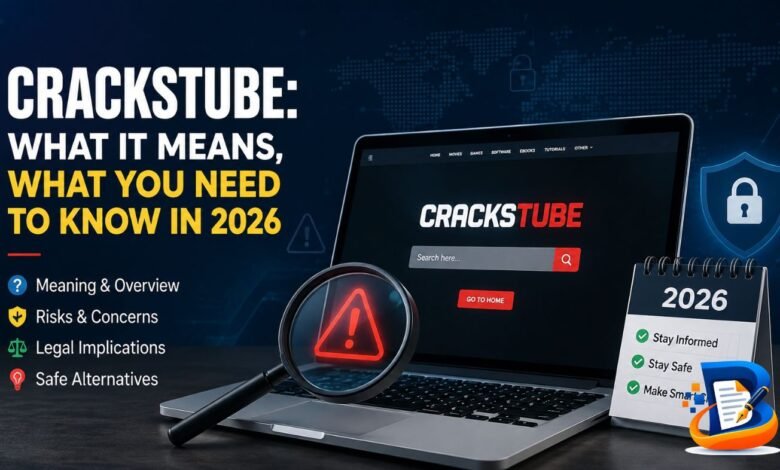
If you searched for Crackstube, you may have noticed something unusual: different search results seem to describe completely different things. Some pages connect the term with digital publishing, while others associate it with software cracks, streaming, or unfamiliar websites. That inconsistency can make a simple search surprisingly difficult to understand.
The key point is that Crackstube does not appear to have one universally consistent meaning across the web. Current search results show multiple websites and pages using the name or a close variation, including publishing-focused platforms and pages discussing piracy-related risks.
For a U.S. reader, that distinction matters. The safest way to evaluate a Crackstube result is to stop treating the keyword itself as proof of what a website is. Instead, look at the exact domain, the type of content it provides, its policies, and what it asks you to do.
This guide explains the confusion around Crackstube, how different versions of the name appear online, what to check before trusting a site, and what safer choices look like when a search result involves downloads, streaming, or unfamiliar services.
What Is Crackstube?
Crackstube is best understood as a search term used by multiple websites and online content projects rather than a name with one clearly established meaning.
A current search for the term produces several different interpretations. One site presents CracksTube.com as a digital publishing platform covering areas such as technology, business, finance, services, home decor, and healthcare. Another website uses Crackstube as the name of an educational content platform focused on internet and technology explanations. Meanwhile, other articles use the term when discussing unofficial software or media websites.
That means a reader should not automatically assume that every page mentioning Crackstube belongs to the same organization.
The domain is therefore more important than the keyword.
For example, a page on a publishing-oriented domain and a page offering an unfamiliar software download may share similar wording in their names while having completely different operators, purposes, and risk profiles.
This is the central issue behind the Crackstube search experience: the word alone does not provide enough context.
Why Does the Crackstube Search Term Cause So Much Confusion?
The confusion comes from the way internet users, websites, and search engines handle names.
A memorable word can be reused by different websites. Once that happens, articles can begin associating the same term with different subjects. Search engines then have to determine which pages are relevant to a query without relying only on a single official definition.
The result can be a mixed search landscape.
Current results demonstrate this clearly. CracksTube.com describes itself as a multi-category publishing platform, while other domains use the Crackstube name for unrelated editorial projects. At the same time, some pages use the term specifically when discussing cracked software, unauthorized media, and online safety.
This does not automatically mean that one result is genuine and everything else is fake.
It means the reader needs to identify the exact website behind the result.
That is a much better approach than deciding whether “Crackstube” is safe or unsafe as a single concept.
Crackstube and CracksTube.com Are Not Automatically the Same Thing
One of the most important distinctions is between the keyword “Crackstube” and a specific domain such as CracksTube.com.
A current page associated with CracksTube.com describes the site as a digital publishing platform that publishes articles across multiple categories. Its content includes areas such as technology, business, professional services, home decor, healthcare, finance, law, and real estate.
A separate website also uses “Crackstube” as part of its branding while describing itself as an educational platform for explaining internet and digital topics.
These examples demonstrate why domain verification matters.
A search result may contain the word Crackstube, but that does not tell you who operates the page or what the page actually offers. The domain name, site navigation, contact information, privacy policy, and actual content provide much stronger context.
The following comparison illustrates the difference.
| Search result type | What it may represent | What to check |
|---|---|---|
| Publishing website | Articles, guides, guest contributions, or digital media | About page, categories, editorial information, contact details |
| Educational website | Explanations about technology or internet topics | Author information, policies, content quality, domain identity |
| Software-download page | Software, applications, installers, or activation-related material | Download behavior, file type, reputation, security warnings |
| Streaming-related page | Video or media content | Licensing information, redirects, advertisements, domain ownership |
| Lookalike domain | A site using a similar name without being the same service | Exact spelling, domain extension, and independent verification |
The table is not a classification of every Crackstube-related website. It simply shows why the name itself is insufficient to judge a result.
What Does CracksTube.com Appear to Offer?
Based on current website information, CracksTube.com presents itself as an article-based publishing platform rather than a software-download service. Its published material describes coverage across technology, business, services, home decor, healthcare, finance, law, and other informational categories.
That positioning is significant because the name can create a different expectation.
Someone who sees the word “crack” may immediately think about software cracking or unauthorized access to paid products. However, a website’s actual purpose has to be determined from the site itself rather than from one word in its name.
Current third-party technical information also identifies crackstube.com as an HTTPS-enabled domain and reports that the hostname resolves through infrastructure associated with Cloudflare. Those technical observations can help establish that a domain exists, but they do not by themselves prove editorial quality, ownership, safety, or trustworthiness.
That distinction is important.
A valid HTTPS connection protects communication between a browser and a website in certain ways. It does not mean every piece of content on the website is trustworthy, nor does it guarantee that every claim made by the site is accurate.
Is Crackstube a Software Cracking Website?
There is no reliable basis for treating every website using the Crackstube name as a software-cracking service.
Some search results do associate Crackstube with cracked software, unauthorized streaming, or piracy-related websites. Other results clearly describe publishing or educational platforms instead.
Therefore, the more accurate answer is: it depends on the specific domain and page you are looking at.
If a page offers cracked applications, license keys, key generators, unauthorized downloads, or similar material, you should evaluate that page according to the risks associated with those activities. If another page simply publishes articles, then the situation is fundamentally different.
The name alone cannot settle the question.
Is Crackstube Safe?
There is no single safety verdict that can responsibly apply to every website using the Crackstube name.
A specific website should be evaluated on its own.
For a publishing or informational site, you can examine whether it has a clear identity, accessible policies, consistent content, contact information, and a coherent site structure. For a download-focused website, the evaluation needs to be considerably stricter because downloading unknown software creates additional security concerns.
The Federal Trade Commission and other cybersecurity organizations routinely recommend caution around suspicious links, unexpected downloads, and requests for sensitive information. For U.S. users, that basic principle applies regardless of what name appears in a website’s header.
A useful rule is simple: never assume that a search result is safe merely because it appears in Google.
Search visibility and website safety are separate questions.
How to Check Whether a Crackstube Website Is Legitimate
The first thing to check is the exact domain.
Look carefully at every character. A domain with a familiar name can still be completely unrelated if it uses a different extension, spelling, hyphen, number, or additional word.
Next, examine what the website actually does.
A normal publishing site should look like a publishing site. You should be able to navigate between articles, categories, author pages, policies, and contact information without being pushed toward unexplained downloads.
The same principle works in reverse. If a page claims to be a media publication but immediately pushes executable downloads or suspicious browser extensions, that behavior deserves attention.
The website’s policies are another useful signal.
A functioning publication may provide privacy information, terms of use, copyright information, or a way to contact the operator. The existence of these pages does not guarantee that a website is trustworthy, but their absence can make independent evaluation harder.
Finally, look beyond the website itself.
Search the exact domain name together with words such as “review,” “security,” or “complaint.” Independent results can sometimes reveal problems that are not obvious from the website’s own pages.
Why Cracked Software Deserves Extra Caution
The safety discussion becomes more serious when a Crackstube-related result offers cracked software.
Cracked software generally refers to software that has been modified to bypass licensing, activation, or other restrictions. From a security perspective, the problem is that a user may have no reliable way to know what else was changed in an unofficial installer.
The installer may appear to perform the same function as legitimate software while containing additional code.
That creates a fundamentally different risk from reading an ordinary article.
A legitimate software provider can publish updates, security fixes, documentation, and support information. An unofficial modified installer does not provide the same level of accountability.
For that reason, U.S. users looking for software should generally start with the developer’s official website, a recognized app store, or another authorized distribution channel.
What About Crackstube and Streaming?
Streaming creates a similar distinction.
A website that hosts or links to unauthorized media may operate very differently from a legitimate streaming service. The concern is not simply whether a video plays. Users also need to consider licensing, advertising practices, redirects, privacy, and the possibility of deceptive pages.
A page that repeatedly opens new tabs, displays fake browser warnings, or claims that a special player or extension is required should be treated carefully.
You do not need to click through a suspicious prompt to find out whether it is legitimate.
Closing the page is often the better decision.
Common Red Flags on Unfamiliar Websites
Certain behaviors deserve immediate attention regardless of the website’s name.
A forced download is one example. If a site claims that you need an unknown application, browser extension, or “download manager” before you can access ordinary content, pause before installing anything.
Unexpected antivirus warnings are another major warning sign. Legitimate software should not require you to casually disable your security tools simply to complete installation.
Aggressive redirects also matter. If clicking an ordinary article repeatedly sends you to unrelated pages, the experience is not behaving like a normal informational website.
Requests for sensitive information deserve similar caution. A website should have a clear reason for requesting payment details, passwords, government identification, or other sensitive information. If the request appears unrelated to the service you expected, stop and investigate.
What Should You Do If You Already Visited a Suspicious Crackstube Page?
Simply opening a webpage does not automatically mean that your computer has been compromised.
However, your next steps should depend on what happened while you were there.
If you only viewed an article and did not download anything, enter credentials, or interact with suspicious prompts, there may be little reason to panic.
If you downloaded a file, installed software, entered a password, or provided payment information, take the situation more seriously.
Do not open an unknown downloaded file merely to see what it contains. If you installed something suspicious, use your operating system’s security tools or a reputable security product to perform a scan.
If you entered a password on a suspicious website, change that password through the legitimate service. If the same password was reused elsewhere, change it there as well.
If payment information was exposed, contact the relevant financial institution through its official contact method and explain what happened.
The goal is not to panic. The goal is to limit the possible damage.
Crackstube Search Results: What Should You Trust?
The best approach is to evaluate the specific result, not the keyword.
| Question | Why it matters |
| What is the exact domain? | Similar names can belong to unrelated websites |
| What does the site actually provide? | Publishing, streaming, and software downloads carry different considerations |
| Does the site explain who operates it? | Clear identity improves accountability |
| Are policies available? | Privacy and terms information can help explain how the site operates |
| Does it demand an unexpected download? | Unnecessary downloads can introduce security risks |
| Does it redirect aggressively? | Repeated redirects can indicate a poor or deceptive browsing environment |
| Is sensitive information requested? | Unexpected requests should always be investigated |
| Can the information be verified elsewhere? | Independent confirmation reduces reliance on one source |
This approach is more reliable than looking for a simple “safe” or “unsafe” label.
What Are Safer Alternatives to Cracked Software?
If the reason you searched for Crackstube was to find free software, there are legitimate alternatives worth considering.
Many software categories have open-source or free versions. For example, users may find free tools for image editing, office productivity, video editing, graphic design, programming, and file management.
The exact alternative depends on what you need.
For professional software, check whether the developer offers a free tier, trial, student option, community edition, or lower-cost plan. Software developers often provide legitimate ways to test a product without downloading an unofficial modified version.
This approach also has a practical advantage: legitimate software can receive security updates and compatibility fixes through an established distribution channel.
What If You Were Looking for Free Streaming?
The same principle applies to video and entertainment.
Instead of relying on an unfamiliar streaming page, look for services that clearly identify their content rights and business model. Depending on the content, legitimate free options may include ad-supported services, broadcaster websites, library services, or official channels.
The important distinction is not simply whether you have to pay.
It is whether the source has a legitimate reason to provide the content.
Crackstube for Readers and Content Creators
Another part of the current search landscape involves Crackstube-related publishing platforms.
CracksTube.com currently presents itself as a multi-category publishing destination and describes opportunities for contributors and guest authors.
Other websites using similar branding also describe digital publishing and educational content.
For writers or marketers, this creates an important distinction between reading a publication and evaluating it as a publishing opportunity.
A contributor should not judge a publication solely by its name or by a promise of SEO benefits. Before submitting content, examine the site’s existing articles, editorial standards, audience relevance, author information, linking policies, and reputation.
A backlink alone is not a substitute for a relevant audience or useful content.
Does Crackstube Have One Official Website?
This is one of the questions where precision matters most.
Current search results show several websites using “Crackstube” or “CracksTube” in their branding. CracksTube.com presents itself as a publishing platform, while other domains use similar terminology for different editorial projects.
Because multiple domains currently use the name or a close variation, it would be misleading to declare that every Crackstube result belongs to one organization.
When you see a specific URL, evaluate that URL directly.
That is the most dependable way to avoid confusing unrelated websites.
Frequently Asked Questions About Crackstube
What does Crackstube mean?
Crackstube is a web search term associated with multiple websites and interpretations. Current results include publishing and educational platforms as well as pages discussing cracked software, unauthorized media, and online safety.
Is Crackstube one website?
Not necessarily. Multiple domains currently use Crackstube or CracksTube branding. Therefore, the exact domain is essential when determining what a particular search result represents.
Is CracksTube.com a publishing website?
CracksTube.com currently presents itself as a multi-category digital publishing platform with articles covering areas including technology, business, services, home decor, healthcare, finance, law, and real estate.
Is Crackstube associated with cracked software?
Some websites and articles associate the term with cracked software or piracy-related content, but that association should not automatically be applied to every website using the name. The exact domain and its actual content determine what you are dealing with.
Is Crackstube safe to visit?
There is no single safety answer for every Crackstube-related domain. Evaluate the specific website, especially if it requests downloads, extensions, credentials, payment information, or other sensitive actions.
Should I download software from a Crackstube-related website?
If the software is offered through an unofficial download source, using the developer’s official website or an authorized store is generally the safer choice. Modified software can create security and reliability concerns that are difficult for an ordinary user to evaluate.
Why do Crackstube search results look different from one another?
Multiple websites use the name or similar branding for different purposes. As a result, search engines can return publishing, educational, streaming-related, or security-focused pages for similar queries.
What should I check before trusting a Crackstube website?
Start with the exact domain. Then check what the site actually offers, who appears to operate it, whether policies and contact information are available, and whether it uses suspicious downloads, redirects, or unexpected requests for personal information.
What if a Crackstube page asks me to install an extension?
Do not install an unfamiliar extension simply because a webpage says it is required. Close the prompt and verify the requirement through the legitimate service’s official documentation or website.
Final Thoughts
The most useful thing to understand about Crackstube is that the keyword does not tell the whole story.
Current search results show a fragmented landscape in which “Crackstube” and “CracksTube” can refer to different publishing projects, educational websites, and pages associated with software or unauthorized media.
That is why a simple safe-or-unsafe verdict is not enough.
Instead, identify the exact domain, determine what the website actually does, and pay attention to how it behaves. A normal article website should not need unexplained downloads to display an article. An unfamiliar software source should not be trusted simply because it appears in search results. And a website’s name should never replace independent verification.
If your goal is information, use a clearly identified publishing or educational source. If your goal is software, use an authorized distribution channel. If your goal is streaming, look for a service with a clear and legitimate content model.
In other words, Crackstube is best approached as an ambiguous search term rather than a single guaranteed destination. Once you make that distinction, the search becomes much easier to understand—and much safer to navigate.