
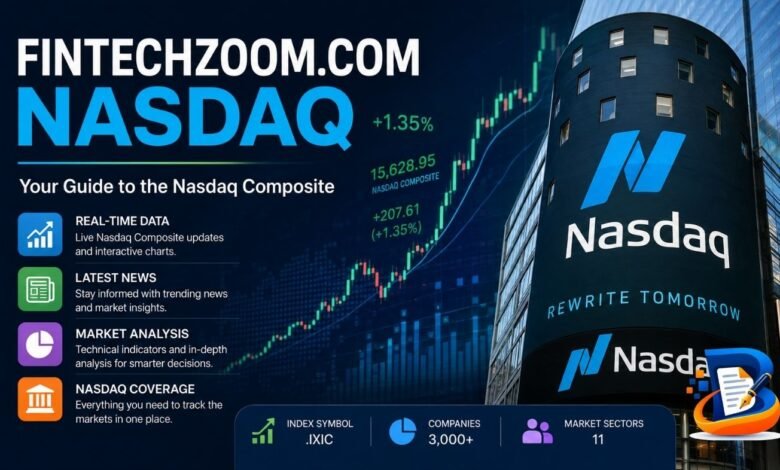
If you searched for fintechzoom.com nasdaq, you are likely looking for a simple way to understand or track the Nasdaq Composite Index, its market movements, charts, news, and related companies. FintechZoom.com has a dedicated Nasdaq page that presents the Nasdaq Composite under the symbol .IXIC and combines market information with charts, technical data, and related news.
However, there is an important distinction to understand: FintechZoom.com is a financial information website, while Nasdaq is the U.S. stock exchange and the organization behind several major market indexes. The Nasdaq Composite itself is an index rather than a company or trading platform.
For U.S. investors, understanding that difference can make financial information much easier to interpret. This guide explains what Fintechzoom.com Nasdaq refers to, what the Nasdaq Composite measures, how to read the information, how it differs from the Nasdaq-100, and what investors should verify before making financial decisions.
What Is Fintechzoom.com Nasdaq?
The phrase fintechzoom.com nasdaq generally refers to FintechZoom.com’s coverage and tracking page for the Nasdaq Composite Index.
FintechZoom.com currently has a dedicated page titled “NASDAQ FintechZoom, NASDAQ Composite Index Live updates.” The page identifies the Nasdaq Composite with the market symbol .IXIC and presents information through charts, performance data, technical indicators, and news.
FintechZoom.com’s broader website also organizes Nasdaq under its world-indices section alongside indexes such as the S&P 500 and Dow Jones.
That makes the search term useful for people who want market information in one place. Still, the underlying market benchmark remains the Nasdaq Composite, which is maintained by Nasdaq.
Nasdaq describes the Composite as a broad index containing thousands of stocks listed on the Nasdaq Stock Market. It is market-capitalization weighted and includes companies from all major industry groups, although technology has a particularly large influence.
What Is the Nasdaq Composite?
The Nasdaq Composite is one of the most widely followed U.S. stock market indexes.
Unlike an individual stock, the index does not represent ownership in one company. Instead, it measures the combined performance of eligible stocks listed on the Nasdaq Stock Market.
Nasdaq says the Composite was established in 1971 and includes companies across all 11 ICB industry groups. Those groups include technology, consumer discretionary, health care, financials, and industrials.
The index is also market-cap weighted. Consequently, larger companies have a greater effect on the index than smaller companies.
This explains why people sometimes describe the Nasdaq Composite as a technology-focused benchmark even though it is not technically a technology-only index.
The index contains technology companies, financial companies, health care businesses, consumer companies, industrial firms, and other businesses. Therefore, the Nasdaq Composite provides a broader picture of the Nasdaq-listed equity market than a narrowly defined technology index.
What Does FintechZoom Show for Nasdaq?
The FintechZoom Nasdaq page is designed to help visitors follow the index and related market information.
Its page identifies the Nasdaq Composite as NASDAQ: .IXIC and provides access to different information areas. These include performance, charts, technical information, and news.
The page also describes its Nasdaq tool as a way to monitor market movements and related information. It includes a TradingView-powered chart and links to additional market coverage.
For a reader, this means the page can serve as a starting point for market research. However, the information should not automatically be treated as a recommendation to buy or sell securities.
Market data can change rapidly. Investors should verify current figures against authoritative market sources before acting on them.
FintechZoom.com Nasdaq vs. Nasdaq Itself
One of the easiest ways to misunderstand the search term is to treat FintechZoom and Nasdaq as the same organization.
They are not.
FintechZoom.com is a financial media and information website. Its Nasdaq page provides market-related information and commentary about the Nasdaq Composite.
Nasdaq, meanwhile, operates the Nasdaq Stock Market and maintains indexes such as the Nasdaq Composite. Its official index page provides index methodology, performance information, composition details, and other official data.
The difference matters because investors should know where information originates.
| Item | FintechZoom.com | Nasdaq |
|---|---|---|
| Primary role | Financial information and market coverage | Exchange operator and index provider |
| Nasdaq Composite coverage | Yes | Yes |
| Market symbol discussed | .IXIC | COMP |
| News and commentary | Yes | Yes |
| Official index methodology | Not the primary authority | Yes |
| Investment decisions | Informational resource | Official market/index information, not personal advice |
The table highlights an important point: FintechZoom can help explain and organize market information, while Nasdaq remains the authoritative source for the official index framework.
How the Nasdaq Composite Works
The Nasdaq Composite is market-capitalization weighted.
In simple terms, the market capitalization of a company represents the market value of its outstanding shares. Larger companies therefore have greater influence over an index constructed this way.
Suppose two companies are both included in an index, but one has a substantially larger market capitalization. A major price movement in the larger company will generally have a greater effect on the index.
This structure helps explain why movements in large Nasdaq-listed companies can have a noticeable effect on the Composite.
At the same time, the Nasdaq Composite is much broader than a collection of only the largest technology stocks. Nasdaq states that the index includes companies across all 11 ICB industry groups.
Why Technology Has Such a Large Role
Technology has a particularly strong presence in the Nasdaq Composite.
Nasdaq’s current description says technology accounts for more than half of the index’s weight, while also emphasizing that the Composite includes many other sectors.
This composition gives the index an important relationship with technology and innovation.
When major technology companies experience strong growth, the Nasdaq Composite can benefit. Conversely, when technology and growth stocks face selling pressure, the index can decline significantly.
That does not mean every Nasdaq-listed stock moves in the same direction. Individual companies can perform very differently from the broader index.
For investors, the key lesson is that an index is a summary measure. It does not tell you exactly what is happening to every company inside it.
Nasdaq Composite vs. Nasdaq-100
Another common source of confusion is the difference between the Nasdaq Composite and Nasdaq-100.
They share the Nasdaq name, but they are different indexes with different construction rules.
The Nasdaq Composite covers thousands of eligible Nasdaq-listed stocks. The Nasdaq-100, by contrast, focuses on 100 of the largest non-financial companies listed on the Nasdaq Stock Market, subject to its eligibility and methodology requirements.
Nasdaq itself warns investors that the two indexes should not be treated as interchangeable.
| Feature | Nasdaq Composite | Nasdaq-100 |
|---|---|---|
| Coverage | Broad Nasdaq-listed stock universe | 100 large non-financial Nasdaq-listed companies |
| Industry exposure | All major industry groups | Large non-financial companies |
| Weighting approach | Market capitalization based | Modified market-capitalization methodology |
| Symbol commonly used | COMP / .IXIC on market platforms | NDX |
| Primary use | Broad Nasdaq market benchmark | Large-cap growth-oriented benchmark |
This distinction is especially useful when reading financial articles.
If a report says “Nasdaq rose,” check which Nasdaq index it means. News reports may use “Nasdaq” informally to refer to the Nasdaq Composite, while investment products may track the Nasdaq-100.
How to Read the Nasdaq Number
When you open a Nasdaq Composite page, you will usually see an index value rather than a stock price.
That number represents the calculated level of the index. It is not the dollar price of an individual security.
You may also see a daily change expressed in points and a percentage change.
For example, if an index rises by a certain percentage during a trading session, that percentage tells you how its calculated level changed relative to the relevant previous value.
Investors should pay attention to both the percentage movement and the time period being discussed.
A one-day decline does not necessarily mean a long-term trend has changed. Similarly, a strong one-day gain does not automatically establish a sustainable bull market.
How to Use Fintechzoom.com Nasdaq for Research
The most useful way to approach a financial information page is as part of a broader research process.
FintechZoom’s Nasdaq page provides charts, performance information, technical material, and related news.
A reader can begin by checking the index’s current direction. The next step is to look at the relevant time frame.
Short-term traders may focus on intraday movements, while long-term investors may be more interested in months or years of performance.
News can then provide context. Market movements can result from company earnings, economic data, interest-rate expectations, geopolitical developments, investor sentiment, or changes in expectations about future growth.
The important part is not simply seeing that the Nasdaq moved. The goal is understanding why it moved and whether the explanation applies to your investment.
Why Nasdaq Data Matters to U.S. Investors
The Nasdaq Composite is particularly relevant to U.S. investors because many prominent American businesses are listed on the Nasdaq Stock Market.
Its broad composition also makes it useful as a benchmark for understanding an important portion of the U.S. equity market.
However, it should not be viewed as a complete representation of the U.S. stock market.
The S&P 500, for example, follows a different group of companies and methodology. The Dow Jones Industrial Average is different again.
Consequently, comparing several indexes can provide a more complete market picture.
If the Nasdaq rises while the Dow falls, for example, that does not necessarily indicate that something is wrong with the market. It may simply show that different sectors or groups of companies are behaving differently.
What Can Move the Nasdaq Composite?
Many forces can influence the Nasdaq Composite.
Corporate earnings are one factor. When major companies report stronger or weaker results than investors expected, their stock prices can respond, affecting the index.
Interest rates also matter, particularly for growth-oriented companies. Changes in borrowing costs and expectations about monetary policy can influence how investors value future earnings.
Economic indicators can affect market expectations as well. Employment data, inflation readings, consumer activity, and economic growth can all influence investor sentiment.
Technology trends can matter too. Developments involving artificial intelligence, semiconductors, cloud computing, cybersecurity, software, and other technology segments can affect individual Nasdaq-listed companies and, collectively, the broader index.
International events can also influence U.S. markets because many large American companies operate globally.
The important point is that no single factor controls the Nasdaq every day.
Technical Analysis on FintechZoom Nasdaq
FintechZoom’s Nasdaq page includes technical-analysis information alongside its charting features.
Technical analysis generally examines price and volume behavior to identify patterns or potential levels of interest.
Common technical concepts include moving averages, support, resistance, momentum, and trend analysis.
These tools can be useful for understanding market behavior, particularly for traders. However, technical indicators are not guarantees of future performance.
A moving average, for instance, describes historical price behavior. It does not guarantee where the market will move next.
For that reason, technical information should be considered alongside fundamentals, economic conditions, risk tolerance, and investment objectives.
Is FintechZoom Nasdaq a Trading Platform?
The Nasdaq page is primarily an information and tracking resource.
The presence of market charts and financial information should not be confused with ownership of the underlying securities.
If you want to buy or sell a Nasdaq-listed stock, you generally use a brokerage account that supports securities trading. FintechZoom’s market-information page itself should not be treated as a substitute for a brokerage platform.
Before placing a trade, investors should confirm the security, ticker symbol, order type, current price, and applicable brokerage information through their broker.
Is the Information on Fintechzoom.com Nasdaq Reliable?
The safest answer is that FintechZoom can be useful as a research source, but investors should verify important market information.
FintechZoom’s own Nasdaq page presents the index as a real-time tracking resource and provides market charts and related information.
However, financial data can differ between platforms because of timing, data feeds, market-session status, or other technical factors.
For official index information, Nasdaq’s own index resources are the better reference point. Nasdaq provides the official Composite overview, including its methodology and index information.
This is especially important when you are checking a precise index level, historical value, index composition, or methodology.
What Investors Should Check Before Using Nasdaq Data
A market number without context can be misleading.
First, check the date and time of the data. U.S. stock markets have defined trading sessions, and prices can behave differently during regular hours and extended trading.
Next, identify the index. “Nasdaq” can refer informally to the Nasdaq Composite, while another article may be discussing the Nasdaq-100.
Then check the time frame. A daily chart tells a very different story from a five-year chart.
Finally, consider the source. Financial websites can be useful for discovery and analysis, but official exchange and index-provider information is valuable when precision matters.
Fintechzoom.com Nasdaq and Long-Term Investing
Long-term investors can use Nasdaq information without constantly trading.
For example, an investor might monitor the Nasdaq Composite to understand how technology-heavy portions of the equity market are performing.
That information can then be compared with the performance of the investor’s diversified portfolio.
The Nasdaq Composite can be a useful benchmark, but it does not automatically determine whether an individual portfolio is performing well.
A portfolio may contain bonds, international stocks, small-cap companies, real estate investments, or other assets. Its performance can therefore differ significantly from the Nasdaq.
Long-term investing also requires attention to diversification, fees, taxes, risk tolerance, and time horizon.
Common Mistakes When Searching Fintechzoom.com Nasdaq
One common mistake is assuming that the phrase represents a Nasdaq stock called FintechZoom.
It does not.
Another mistake is assuming the Nasdaq Composite contains only technology companies. Nasdaq explicitly states that the index represents all major industry groups.
Some readers also confuse the index with the Nasdaq Stock Market itself. The exchange is the marketplace where securities are listed and traded, while the Composite is an index measuring the performance of eligible stocks listed there.
Finally, investors sometimes mistake market commentary for personalized financial advice. General market information cannot account for an individual’s financial circumstances.
Fintechzoom.com Nasdaq vs. Other Market Resources
Different platforms serve different purposes.
FintechZoom can be useful for browsing financial news, market explanations, charts, and related coverage. Its Nasdaq page specifically combines index tracking with market content.
Nasdaq’s official resources are particularly useful when you need authoritative information about index methodology, composition, and official index data.
Brokerage platforms are more appropriate when you need account-specific portfolio information or want to place securities trades.
Professional financial-data services may provide deeper analytics and specialized tools.
The best choice depends on the question you are trying to answer.
Frequently Asked Questions
What does fintechzoom.com Nasdaq mean?
Fintechzoom.com Nasdaq generally refers to FintechZoom.com’s coverage and tracking page for the Nasdaq Composite Index. The page identifies the index as NASDAQ: .IXIC and provides charts, performance information, technical material, and related news.
Is FintechZoom the Nasdaq stock exchange?
No. FintechZoom.com and Nasdaq are separate entities. FintechZoom provides financial information and market coverage, while Nasdaq operates the Nasdaq Stock Market and maintains indexes including the Nasdaq Composite.
What is the Nasdaq Composite Index?
The Nasdaq Composite is a market-capitalization-weighted index that tracks thousands of eligible stocks listed on the Nasdaq Stock Market. It includes companies from all major industry groups, with significant exposure to technology.
What is the Nasdaq Composite ticker?
The Nasdaq Composite is commonly identified by the symbol COMP in Nasdaq’s official index system and .IXIC on many market-data platforms. FintechZoom’s Nasdaq page uses .IXIC.
Is the Nasdaq Composite the same as the Nasdaq-100?
No. The Nasdaq Composite is much broader. The Nasdaq-100 focuses on 100 large non-financial companies listed on the Nasdaq Stock Market and follows a different methodology.
Can I buy the Nasdaq Composite directly?
An index itself is not a normal individual stock that you purchase directly. Investors seeking exposure to an index generally use investment products designed to track it. The specific product, fees, structure, and risks should be reviewed before investing.
Does the Nasdaq Composite contain only technology stocks?
No. Although technology has a major influence on the index, the Nasdaq Composite includes companies across all 11 ICB industry groups, including financials, health care, consumer discretionary, and industrials.
Can FintechZoom Nasdaq data be used for investment decisions?
It can be used as part of market research, but important figures should be verified with authoritative sources. Market information does not constitute personalized investment advice, and investors should consider their own objectives and risk tolerance.
Conclusion
Fintechzoom.com Nasdaq is best understood as FintechZoom.com’s coverage and tracking resource for the Nasdaq Composite Index. The page provides market charts, performance information, technical data, and related news, making it useful for readers who want a convenient overview of Nasdaq market activity.
The underlying Nasdaq Composite is much broader than a technology-only index. It contains thousands of Nasdaq-listed stocks and represents companies across multiple industries, although technology has a particularly strong influence on its performance.
For U.S. investors, the most important takeaway is to understand what you are actually looking at. Distinguish the Nasdaq Composite from the Nasdaq-100, separate FintechZoom’s financial coverage from Nasdaq’s official index information, and always check the date, time, index, and source behind market data.
Used that way, fintechzoom.com Nasdaq can be a useful starting point for understanding market movements without confusing an information website with the exchange, the index, or a brokerage account.





One Comment