
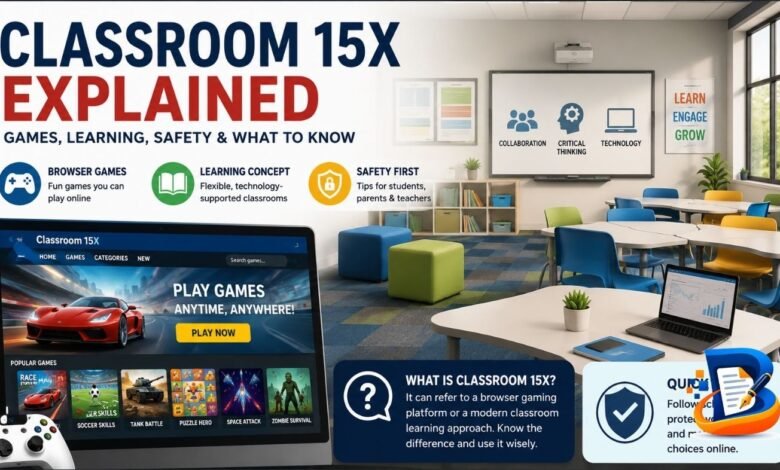
If you searched for classroom 15x, you may have noticed that the term does not point to one clearly defined product or educational program. Current web results use the name in several ways, including browser-based game websites and descriptions of a modern classroom or learning model. That overlap can make it difficult to know what you are actually looking at.
For U.S. students, parents, teachers, and anyone researching the term, the most useful approach is to separate these meanings before deciding whether a particular website or concept is relevant.
This guide explains what Classroom 15x refers to online, why the name is confusing, what kinds of content associated with it may appear on the web, how browser-based gaming fits into the discussion, and what users should consider regarding school policies, privacy, safety, and responsible use.
What Is Classroom 15x?
There is no single, universally established definition of “Classroom 15x” that can be treated as the official meaning of the term.
Recent websites use the phrase differently. Some describe Classroom 15x as a browser-based gaming destination offering games that can be played online. Other pages describe it as an educational concept centered on small-group instruction, flexible classroom layouts, technology, and student-centered learning.
That distinction matters because someone searching for Classroom 15x may have a completely different goal from another visitor.
A student might be looking for a browser game. A teacher might be researching classroom design. A parent might want to know whether a particular site is appropriate for a child. Meanwhile, an SEO page or blog may use the same phrase to describe an educational framework.
Therefore, the safest interpretation is to treat Classroom 15x as a search term with multiple online meanings rather than automatically assuming it refers to one official educational service.
Why the Classroom 15x Search Is Confusing
The biggest issue surrounding the keyword is inconsistent terminology.
Some sites associate Classroom 15x with free browser games and describe the service as a place where users can access games without downloading traditional software. Other sites focus almost entirely on education and describe a classroom environment involving flexible spaces, digital tools, small groups, and personalized instruction.
The two interpretations should not be treated as interchangeable.
| Meaning associated with Classroom 15x | What it generally refers to | Typical audience |
|---|---|---|
| Browser gaming site | Online games accessed through a web browser | Students and casual players |
| Educational classroom concept | Flexible, technology-supported learning environment | Teachers, schools, and students |
| Gamified learning idea | Using game-like activities to support learning | Educators and learners |
Because the name is reused across different websites, users should check the exact domain, purpose, and content before assuming that a particular Classroom 15x page represents an official organization or standardized education program.
Classroom 15x as a Browser Gaming Website
One prominent use of the term relates to websites offering browser-based games.
A current web result describing Classroom 15x presents it as a collection of online games covering different genres. Another site similarly describes Classroom 15X as a destination for free browser games that can be opened online.
Browser games are different from traditional installed games because the basic game experience can run through a web browser. Depending on the particular website and game, users may not need to install a separate desktop application.
However, “browser-based” does not automatically mean “approved by your school.”
That distinction is particularly important for U.S. students. A school district can restrict websites, gaming services, or categories of online content on school-managed devices and networks. A website describing itself as “unblocked” does not override those policies.
Students should follow their school’s acceptable-use rules instead of trying to bypass network restrictions.
What Kind of Games May Appear?
Websites using the Classroom 15x name have been described as carrying different types of browser games, including puzzle, arcade, sports, driving, simulation, and multiplayer titles.
The exact selection can change from one website to another. It can also change over time.
That means it would be inaccurate to assume that every game associated with the keyword is educational, school-approved, or appropriate for every age group.
Parents and teachers should evaluate individual games rather than judging the entire category from the Classroom 15x name alone.
Is Classroom 15x Actually an Educational Platform?
This depends on which website or interpretation you encounter.
Several pages use Classroom 15x to describe a modern approach to education. These descriptions commonly emphasize flexible classroom layouts, technology, personalized learning, collaborative activities, and student-centered instruction.
However, that does not establish that Classroom 15x is a nationally recognized U.S. education standard.
The phrase appears to be used broadly across independent websites. Some pages present it as a framework, while others connect the name with gaming.
For that reason, educators should be cautious about treating statements such as “Classroom 15x improves learning by a specific amount” as established evidence unless the claim is supported by credible, independently verifiable research.
The Classroom 15x Learning Concept
When the term is used as an educational concept, the central idea is usually a move away from rigid classroom structures.
Traditional classrooms often organize students around fixed desks and a teacher-led lesson. A flexible classroom can instead use movable furniture, group work areas, quiet spaces, digital resources, and different arrangements depending on the activity.
The goal is not simply to make a classroom look modern.
Good classroom design should support what students are actually being asked to do.
A discussion may work better when students can face one another. A collaborative project may require tables that can be grouped together. Independent work may benefit from a quieter area.
Technology can support these activities, but it does not automatically improve teaching. The educational value depends on how teachers use the tools and how well they fit the lesson.
Small-Group Learning
Some descriptions of Classroom 15x connect the “15” with smaller groups of students.
Smaller instructional groups can make it easier for teachers to interact directly with students. They may also provide more opportunities for discussion and feedback.
Still, the number 15 should not be treated as a universal rule for effective education. Classroom size requirements and instructional practices vary between schools, districts, grade levels, and subjects.
A classroom with 15 students is not automatically better simply because it has that number.
The quality of instruction, teacher preparation, curriculum, student needs, available resources, and classroom management all matter.
Technology’s Role in Classroom 15x
Technology is another recurring part of the Classroom 15x concept.
Descriptions of the model mention devices and digital resources, while some pages go further by discussing artificial intelligence, virtual reality, augmented reality, and other emerging technologies.
For a U.S. classroom, the practical question should be less about having the newest technology and more about whether the technology solves a real instructional problem.
A digital tool can make it easier to demonstrate an idea, provide practice, collaborate on a document, or give students access to multimedia resources. At the same time, unnecessary technology can create distractions, privacy concerns, accessibility problems, or additional work for teachers.
The strongest implementation starts with the lesson rather than the device.
How Gaming and Learning Can Overlap
The gaming interpretation of Classroom 15x creates another interesting connection with education.
Games can involve decision-making, problem-solving, rules, feedback, and experimentation. Those characteristics can sometimes support learning activities when a teacher deliberately connects a game to an instructional objective.
However, playing a game and learning through a game are not automatically the same thing.
A browser game designed for entertainment does not become educational simply because a student plays it on a school Chromebook.
For a game to have meaningful educational value, educators need to consider the learning objective, age appropriateness, accessibility, content, time spent, and what students are expected to learn from the activity.
Classroom 15x for Students
For students who encounter Classroom 15x through a gaming website, the first question should be whether the site is permitted on the device and network they are using.
School-issued devices are often managed differently from personal computers. District administrators may use content filtering, device-management systems, and acceptable-use policies to control access.
Trying to circumvent those controls can create problems even if a particular game itself appears harmless.
Students should also remember that online gaming sites can contain advertisements, external links, tracking technologies, or third-party content depending on the website.
Before clicking through unfamiliar pages, students should check with a parent, guardian, teacher, or school technology administrator when appropriate.
Classroom 15x for Teachers
Teachers may encounter the term while researching student engagement, classroom design, or browser games.
The most useful approach is to evaluate the underlying educational practice rather than relying on the Classroom 15x label.
For example, a teacher interested in flexible learning could examine whether movable furniture would improve group activities. A teacher considering games could evaluate whether a specific game supports the curriculum. A teacher exploring digital tools could review privacy, accessibility, age suitability, and district approval.
In other words, the name itself should not replace professional evaluation.
Classroom 15x and School Safety
Safety is one of the most important issues when students use unfamiliar websites.
A page being easy to access does not prove that it is safe, educational, or approved for school use.
Teachers and parents should pay attention to the site’s ownership information, privacy practices, advertising, external links, account requirements, and the type of content displayed.
A website that offers free games may also depend on advertising or third-party content. That can introduce material that a school or parent does not want students to encounter.
School Policies Matter
U.S. schools and districts can establish their own technology policies. Those policies may determine which websites students can access, what types of games are allowed, and when entertainment websites may be used.
Consequently, students should not interpret the phrase “unblocked games” as permission to bypass a school filter.
If a school blocks a website, the appropriate response is to follow the school’s rules or ask an administrator whether access can be approved for an educational purpose.
Privacy Considerations
Privacy deserves attention whenever children or students use online services.
Before creating an account, users should understand what information a site requests and why it needs that information. If a gaming website does not require an account, that may reduce the amount of information a user needs to submit, but it does not automatically tell you what information the website collects through other technologies.
Parents should be especially cautious when children are asked to provide names, email addresses, photos, location information, or other personal details.
Schools may also have separate requirements for educational technology platforms, particularly when student information is involved.
The safest practice is to avoid sharing unnecessary personal information and to use school-approved services when the activity is part of formal instruction.
Is Classroom 15x Free?
Some websites using the Classroom 15x name describe their games as free to access.
That does not mean every website using the name has identical pricing or business practices.
Because the term is used by different sites, users should inspect the specific website they are visiting rather than assuming that every Classroom 15x service has the same model.
Free access can also come with advertising or third-party content. Therefore, cost should not be the only factor when deciding whether a site is suitable.
Classroom 15x Compared With a Traditional Classroom
The educational interpretation of Classroom 15x is easiest to understand by comparing its principles with a more traditional classroom setup.
| Area | More traditional approach | Flexible Classroom 15x-style concept |
|---|---|---|
| Seating | Often fixed or arranged in rows | Can be rearranged for different activities |
| Instruction | Frequently teacher-led | Greater emphasis on student participation |
| Group work | May be occasional | Can be built into the classroom structure |
| Technology | May supplement lessons | More deliberately integrated where useful |
| Student support | Whole-class plus individual help | Greater emphasis on differentiated support |
| Physical space | Usually organized around one main arrangement | Multiple learning configurations |
This comparison describes broad ideas rather than a formal national standard. Individual classrooms can combine traditional and modern approaches successfully.
Potential Benefits of a Flexible Classroom Approach
A flexible classroom can make it easier to change the environment based on the activity.
A teacher might use a shared configuration for discussion, rearrange the room for collaborative work, and then create independent work areas later in the same period.
That flexibility can support different teaching methods without requiring separate rooms.
Technology can also expand the range of resources available to students. Digital simulations, multimedia, online research, collaborative documents, and interactive exercises can complement direct instruction.
However, these benefits depend on implementation. Furniture, devices, and software cannot substitute for effective teaching.
Limitations and Challenges
The Classroom 15x concept also has practical limitations.
Flexible furniture costs money. Devices require maintenance. Software needs support. Teachers may need training. Classroom redesign can be difficult in older buildings or spaces with limited room.
There is also a risk of treating technology as the solution to every educational challenge.
A classroom filled with expensive equipment can still struggle if students lack clear instructions, teachers lack adequate support, or the technology creates distractions.
Another issue is consistency. A model that works well for one grade level or subject may require substantial changes before it fits another.
For these reasons, schools should evaluate individual strategies rather than adopting a label without considering their own students and resources.
How Parents Can Evaluate a Classroom 15x Website
Parents who encounter Classroom 15x online should first determine which website they are viewing.
Look at the site’s exact domain and read its description carefully. If the site provides games, examine the types of games and the presence of advertisements or outside links. If it presents itself as an educational platform, check whether it clearly identifies its organization, educational purpose, privacy practices, and supporting information.
Do not assume that a website is affiliated with a school, university, government agency, or established education company unless that relationship can be independently verified.
This is especially important when a site makes strong claims about educational outcomes.
How Students Can Use Online Games Responsibly
Online games can be entertaining, but schoolwork and school technology rules should come first.
If a teacher allows a game as part of an activity, students should use it for the intended purpose. If gaming is not permitted on a school device, students should not attempt to bypass the restriction.
At home, parents can decide what types of games are appropriate and how much screen time fits their household rules.
The key issue is context. A game played during an approved break is different from a game played during a lesson without permission.
Frequently Asked Questions About Classroom 15x
What is Classroom 15x?
Classroom 15x is an ambiguous online term. Some websites use it for browser-based gaming platforms, while others use it to describe a flexible, technology-supported classroom or learning concept.
Is Classroom 15x an official U.S. education program?
There is no reliable basis for treating the term itself as a standardized U.S. education program. Different websites use the name for different purposes, so users should verify the specific organization or website behind any particular claim.
Is Classroom 15x a gaming website?
Some websites using the Classroom 15x name are described as browser-based gaming platforms. The exact games and features depend on the particular domain being visited.
Are Classroom 15x games educational?
Not necessarily. Some games may involve skills such as problem-solving or strategy, but an online game should not automatically be considered an educational resource. Teachers should evaluate individual games against their learning objectives.
Can students use Classroom 15x at school?
That depends on the school’s technology and acceptable-use policies. Students should not assume that a site described online as “unblocked” is permitted on a school network.
Does 15x mean there are exactly 15 students?
Not necessarily. Some descriptions connect the term with small groups of approximately 15 students, while other websites use the name for entirely different purposes.
Is Classroom 15x safe for children?
Safety depends on the specific website and the content it provides. Parents should review the site’s content, privacy practices, advertisements, external links, and account requirements before allowing children to use it.
Should teachers use Classroom 15x?
Teachers should first determine which Classroom 15x resource they are considering. If it is a gaming website, the teacher should evaluate the individual games and school policy. If it refers to a classroom-design concept, educators can evaluate the underlying practices independently of the name.
Conclusion
Classroom 15x is best understood as a term with multiple meanings rather than one clearly defined product. Online results currently connect the name with browser-based games as well as a broader idea involving flexible classrooms, technology, small-group instruction, and student-centered learning.
That distinction is important for U.S. readers. Students should follow school technology policies rather than assuming that an “unblocked” label gives them permission to access a site. Parents should review online content and privacy considerations before allowing children to use unfamiliar platforms. Teachers should evaluate educational tools based on their actual instructional value instead of the name attached to them.
Ultimately, the most useful way to approach Classroom 15x is to identify the specific website or educational concept you mean, verify its claims, and consider whether it fits your particular learning or classroom needs.


One Comment